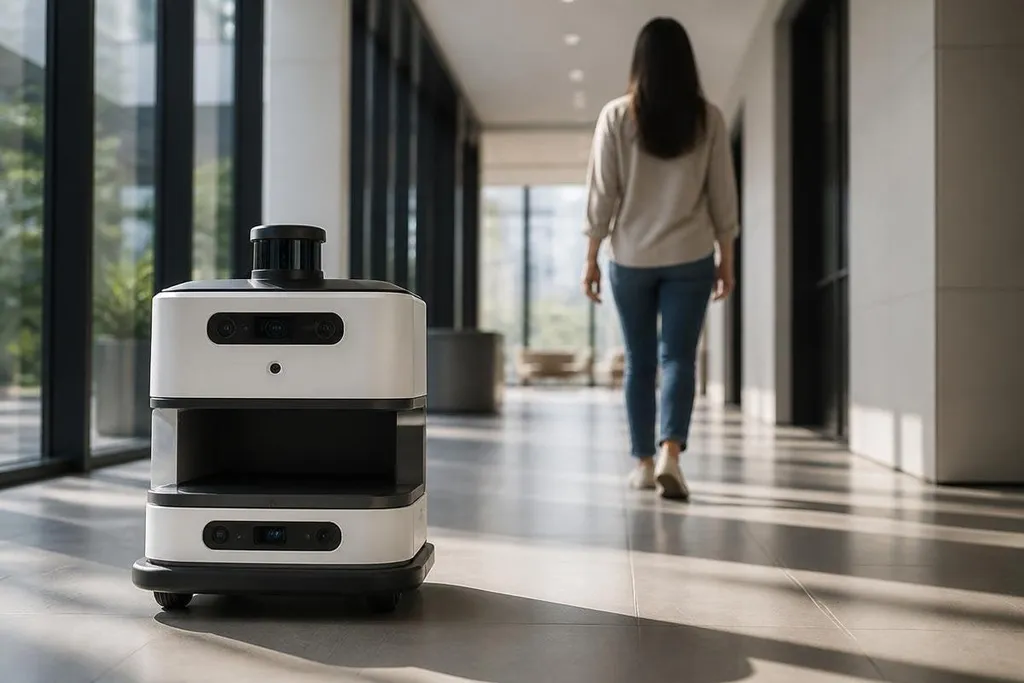
A mobility robot must answer three questions while it moves: where am I, what is around me, and what should I do next? AI helps with those answers by turning camera, LiDAR, and wheel data into movement decisions, but it doesn't remove the need for careful maps, sensors, or safety rules.
- Cameras and LiDAR help the robot read nearby space.
- Software predicts paths instead of following one fixed route.
- Safety limits still decide when the robot must stop.
From sensor data to a usable map
A moving robot collects raw data from several sensors. A camera can identify a person or doorway, LiDAR measures distance with laser pulses, and an inertial measurement unit records changes in motion. AI models help sort those signals into objects and free space.
That matters because a map alone is not enough. A delivery robot may know where a corridor is, then find a trolley blocking it. The software must spot the obstacle, estimate its position, and decide if the robot can pass safely.
Many systems use simultaneous localization and mapping, or SLAM. The robot builds a map while estimating its own position inside it. AI can help match new sensor readings with earlier parts of the map, especially when the scene contains repeated shapes such as shelves or doors.
Planning paths that can change
Older mobile robots often work well in spaces with fixed routes and marked stops. AI gives the control system more room to react when people, vehicles, or loose objects change the route.
A path planner weighs distance, turning space, speed limits, and nearby hazards. It may slow down near a person, stop at a crossing, or choose another route when a passage closes. The robot still needs rules that limit speed and keep a safe gap from people.
This is where the word “autonomous” needs care. A robot may drive itself across a known site while still needing a remote operator for blocked paths, sensor faults, or tasks outside its training data.
The useful question is not whether the robot runs alone. It is how often a person must step in, and what happens when they do.
A mobility robot can change its route after reading new sensor data, so an AI claim needs the robot, software version, trial date, and human control rule named beside it. AI mobility robot reporting can supply that record before the discussion turns to how movement data shapes its decisions.
Learning from movement
AI can also improve how a robot moves. A control model can link sensor input to wheel speed, steering, or leg motion. With enough safe training data, the robot may handle surfaces and turns that were hard to describe with hand-written rules.
Training data remains a weak point. A model trained on clean floors may react poorly to wet ground, low light, dust, or a crowded work area. Simulation can produce many training cases, but a simulated wheel slip does not prove that the physical robot will recover from one.
I’d judge a mobility robot by its failure handling before its smoothest demo. A system that stops safely and asks for help has a useful place; a system that guesses when its sensors disagree creates a work problem.
Where the limits remain
AI does not fix worn tyres, a dirty LiDAR lens, a low battery, or a missing map. It also cannot turn a narrow aisle into a wide one. The physical design still sets the robot’s speed, turning radius, ground clearance, payload, and operating time.
Safety needs a separate layer around the AI model. Emergency stops, speed limits, collision detection, and restricted zones should work even when the model makes a poor prediction. Operators also need logs that show what the robot sensed, chose, and did after a fault.
For a warehouse manager or site engineer, the cost of human intervention may matter more than the model’s success rate in a test area. A robot that needs help twice each shift may fit one job and fail another, even if both sites use the same software.
A practical buying check
Before approving a mobility robot, check these points:
- Test the route: run the robot through blocked paths, poor lighting, slopes, and busy crossings.
- Count interventions: record how often a person takes control during a full shift.
- Check recovery: confirm what the robot does after lost positioning, sensor dirt, or low battery.
- Review the logs: make sure staff can find the cause of a stop without calling the maker.
- Set safety limits: define speed, stopping distance, access zones, and who can restart the robot.
AI earns its place when it cuts manual route setup and handles normal changes without hiding failures. The next useful measure is intervention time: how many minutes a person spends helping each robot during a real shift.